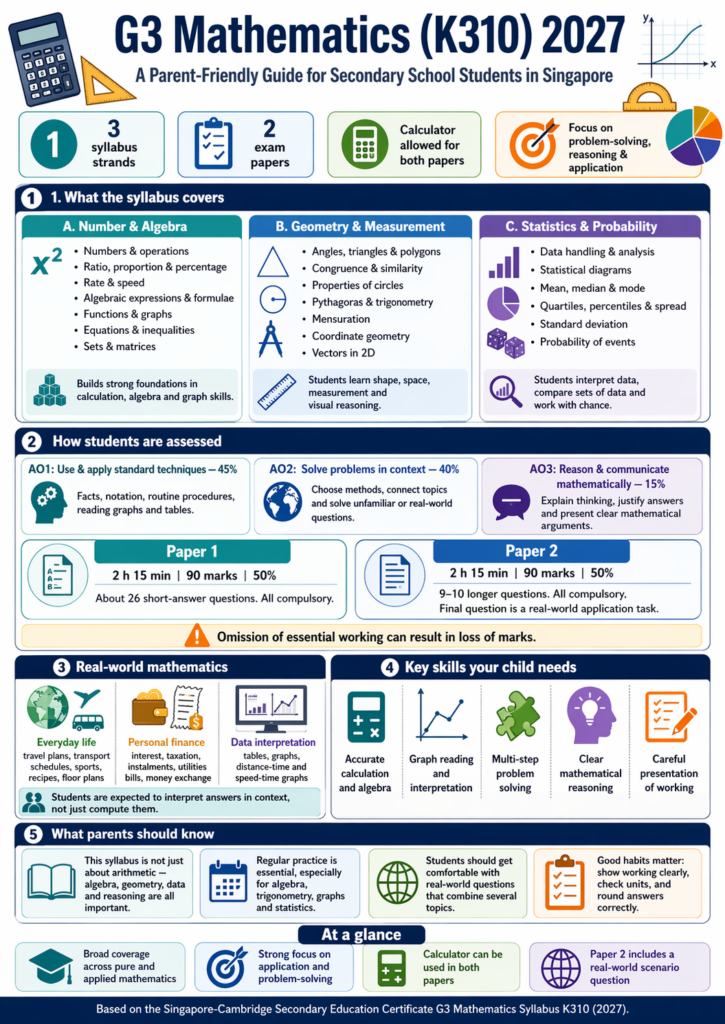
Gradient, length of line segment, equation of straight line, coordinate-based geometry problems
G7 Vectors in two dimensions
Vector notation, translation, position vectors, magnitude, vector addition/subtraction, scalar multiplication, geometry with vectors
C. Statistics and Probability
Topic
Key content
S1 Data handling and analysis
Tables, bar graphs, pictograms, line graphs, pie charts, dot diagrams, histograms, stem-and-leaf diagrams, cumulative frequency, box plots, mean, median, mode, quartiles, percentiles, range, interquartile range and standard deviation
S2 Probability
Probability of single events, combined events, possibility diagrams, tree diagrams, mutually exclusive events and independent events
5. Real-world problem-solving
The syllabus includes questions based on real-life contexts such as:
Context
Examples
Everyday life
Travel plans, transport schedules, sports, recipes, floor plans, navigation
Finance
Simple and compound interest, taxation, instalments, utilities bills, money exchange
Data interpretation
Tables, graphs, distance-time graphs and speed-time graphs
The last question in Paper 2 specifically focuses on applying mathematics to a real-world scenario.
6. What students should prioritise
Priority area
Why it matters
Algebra and equations
Forms the backbone of many topics, including graphs and problem-solving
Graphs and functions
Important for both pure math and real-world interpretation
Geometry and trigonometry
Requires strong visual reasoning and formula use
Mensuration
Common in real-world and composite-shape questions
Statistics
Data interpretation is heavily linked to real-life contexts
Clear working
Omission of essential working can lead to loss of marks
Problem-solving practice
Paper 2 includes longer, multi-step real-world questions
Overall, G3 Mathematics K310 is a broad mathematics syllabus that tests not only calculation skills, but also application, reasoning, communication and real-world problem-solving.
Contains information related to marketing campaigns of the user. These are shared with Google AdWords / Google Ads when the Google Ads and Google Analytics accounts are linked together.
90 days
__utma
ID used to identify users and sessions
2 years after last activity
__utmt
Used to monitor number of Google Analytics server requests
10 minutes
__utmb
Used to distinguish new sessions and visits. This cookie is set when the GA.js javascript library is loaded and there is no existing __utmb cookie. The cookie is updated every time data is sent to the Google Analytics server.
30 minutes after last activity
__utmc
Used only with old Urchin versions of Google Analytics and not with GA.js. Was used to distinguish between new sessions and visits at the end of a session.
End of session (browser)
__utmz
Contains information about the traffic source or campaign that directed user to the website. The cookie is set when the GA.js javascript is loaded and updated when data is sent to the Google Anaytics server
6 months after last activity
__utmv
Contains custom information set by the web developer via the _setCustomVar method in Google Analytics. This cookie is updated every time new data is sent to the Google Analytics server.
2 years after last activity
__utmx
Used to determine whether a user is included in an A / B or Multivariate test.
18 months
_ga
ID used to identify users
2 years
_gali
Used by Google Analytics to determine which links on a page are being clicked
30 seconds
_ga_
ID used to identify users
2 years
_gid
ID used to identify users for 24 hours after last activity
24 hours
_gat
Used to monitor number of Google Analytics server requests when using Google Tag Manager
1 minute
Marketing cookies are used to follow visitors to websites. The intention is to show ads that are relevant and engaging to the individual user.
A video-sharing platform for users to upload, view, and share videos across various genres and topics.
Registers a unique ID on mobile devices to enable tracking based on geographical GPS location.
1 day
VISITOR_INFO1_LIVE
Tries to estimate the users' bandwidth on pages with integrated YouTube videos. Also used for marketing
179 days
PREF
This cookie stores your preferences and other information, in particular preferred language, how many search results you wish to be shown on your page, and whether or not you wish to have Google’s SafeSearch filter turned on.
10 years from set/ update
YSC
Registers a unique ID to keep statistics of what videos from YouTube the user has seen.
Session
DEVICE_INFO
Used to detect if the visitor has accepted the marketing category in the cookie banner. This cookie is necessary for GDPR-compliance of the website.
179 days
LOGIN_INFO
This cookie is used to play YouTube videos embedded on the website.